
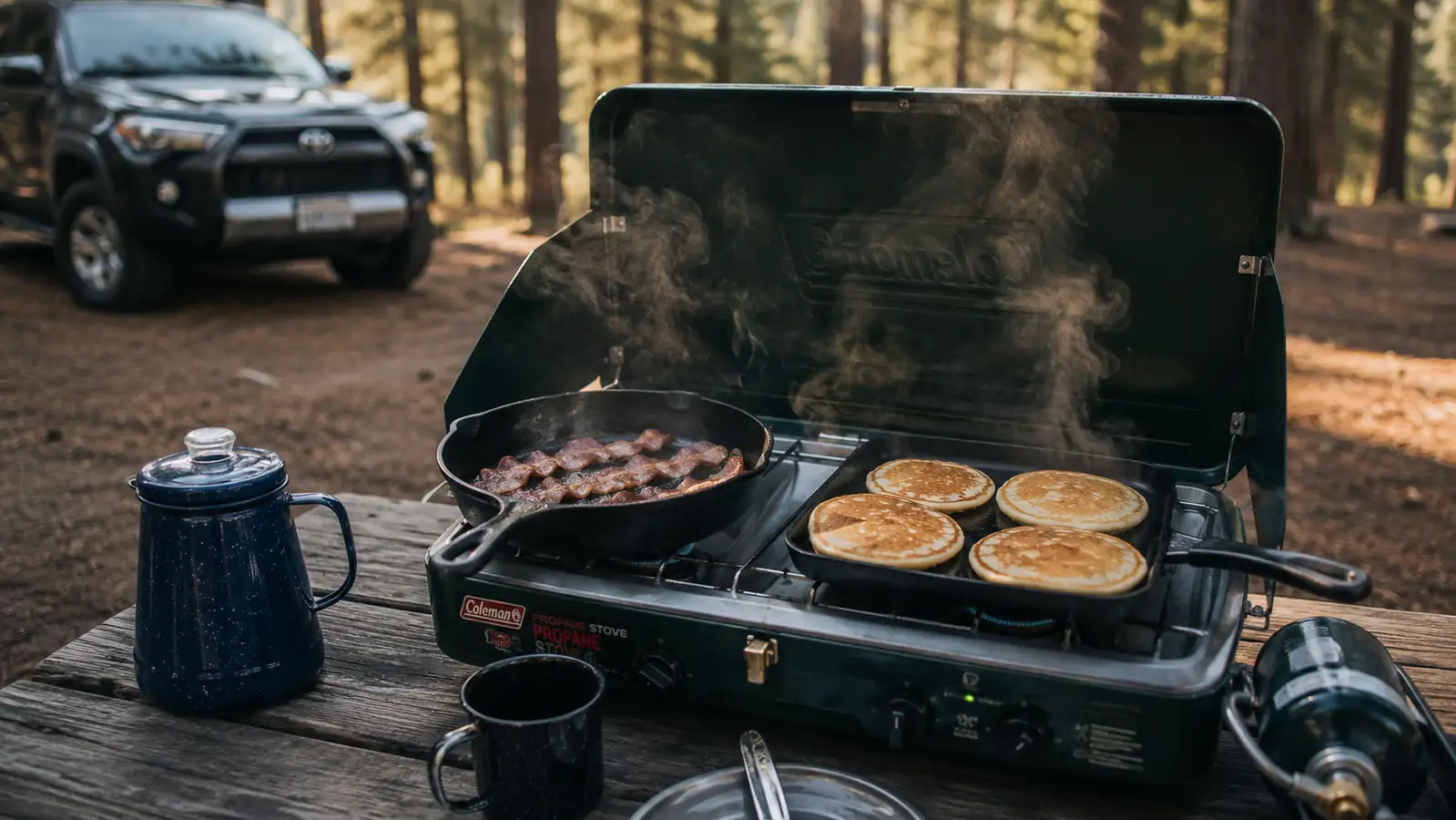
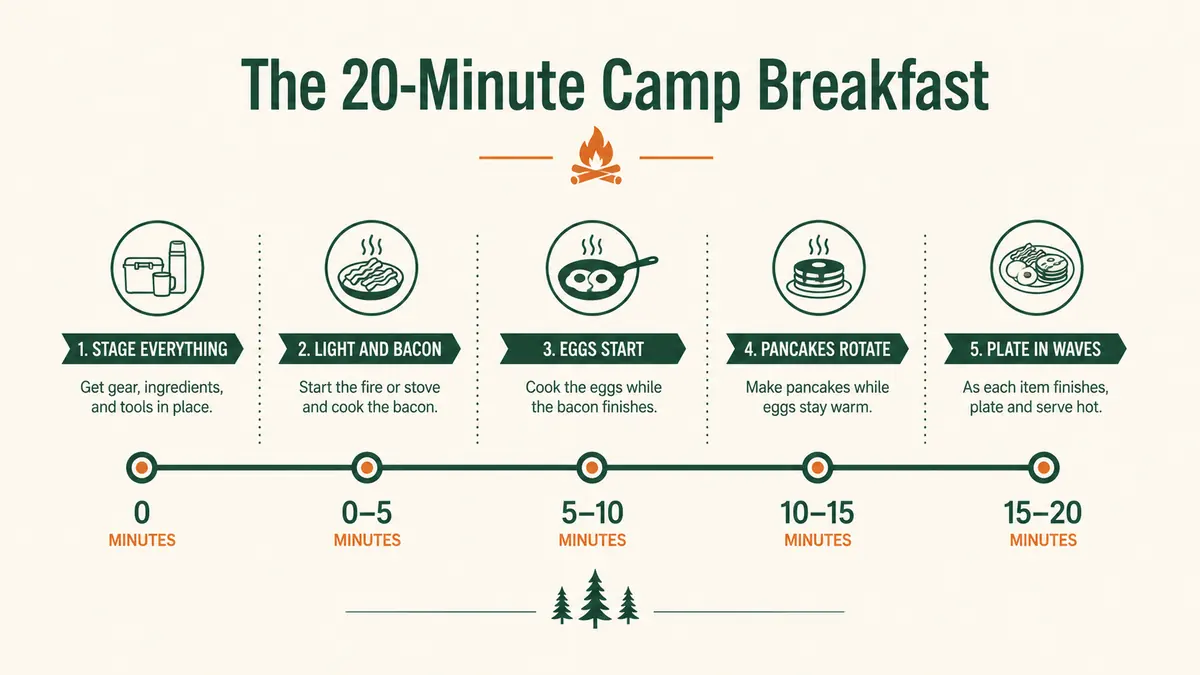
Twenty minutes. That's the real number, not a magazine number, that I've gotten camp breakfast down to with two kids who wake up hungry and don't have a lot of patience for waiting on food. Bacon, eggs, and pancakes, three separate cooks that used to take me almost forty five minutes on a single burner, one after another while everyone stood around the picnic table asking when it would be ready. The gap closed the morning I stopped treating the stove like an afterthought and started treating breakfast like an actual sequence, planned out the same way I'd plan a hike. The tool that made the sequence possible is the Coleman Triton+ 2-Burner stove, and this is the exact order I run it in every single time we're at Beavers Bend, Robbers Cave, or wherever the tents happen to be pitched that weekend.
This isn't a review, I've already written that one. This is the actual workflow, step by step, built around one goal, getting three different foods hot and on plates within twenty minutes of the propane bottle going on, using two burners instead of one. It matters more than people think. A single-burner setup means everything happens in sequence, bacon then eggs then pancakes, and the first plate's cold by the time the last one's ready. Two burners running at the same time on the Triton+ changes the math completely, but only if you actually plan the order instead of just turning both knobs and hoping it works out. The first few times I tried it without a plan, I ended up with cold bacon and rubbery eggs, and it took me longer to sort out than it would've taken to just cook everything one pan at a time.
The stove that turns three cooks into one twenty-minute pass
Everything in this workflow assumes a two-burner stove that lights the first time and holds real heat on both sides. That's the Coleman Triton+, still the first thing loaded into our 4Runner every trip. Check today's price on Amazon.
Amazon Check Today's Price on Amazon →Step 1: Stage Every Ingredient and Pan Before You Light Anything
The biggest time-saver has nothing to do with the stove itself. It's staging, and I do it before Nolan and Ivy are even fully out of the tent. Bacon comes out of the cooler and gets set on the picnic table. Eggs get cracked into a bowl and whisked at home the night before, poured into a leakproof container, so I'm not standing there cracking shells into a hot pan while bacon's already going. Pancake mix, if we're not doing the just-add-water kind, gets pre-measured into a labeled bag before we ever leave the driveway. Nothing gets prepped for the first time at the campsite. Everything's already staged, and the only decisions left to make are about timing, not ingredients.
I also lay out both pans and the spatula, tongs, and a plate for resting bacon before I touch the propane. Sounds obvious, but the number of mornings I've gone hunting through a gear tub for tongs while bacon's already spitting grease is embarrassing. Two minutes of staging with a cold stove beats thirty seconds of panic with a hot one, and it's the difference between a calm cook and one where I'm narrating apologies to two kids who are done waiting. I keep a small canvas bag just for this staging kit, spatula, tongs, a folding cutting board, so it's one grab out of the 4Runner instead of digging through three different tubs while everyone's watching the clock.
Step 2: Light Both Burners at Once and Send Bacon to the Left
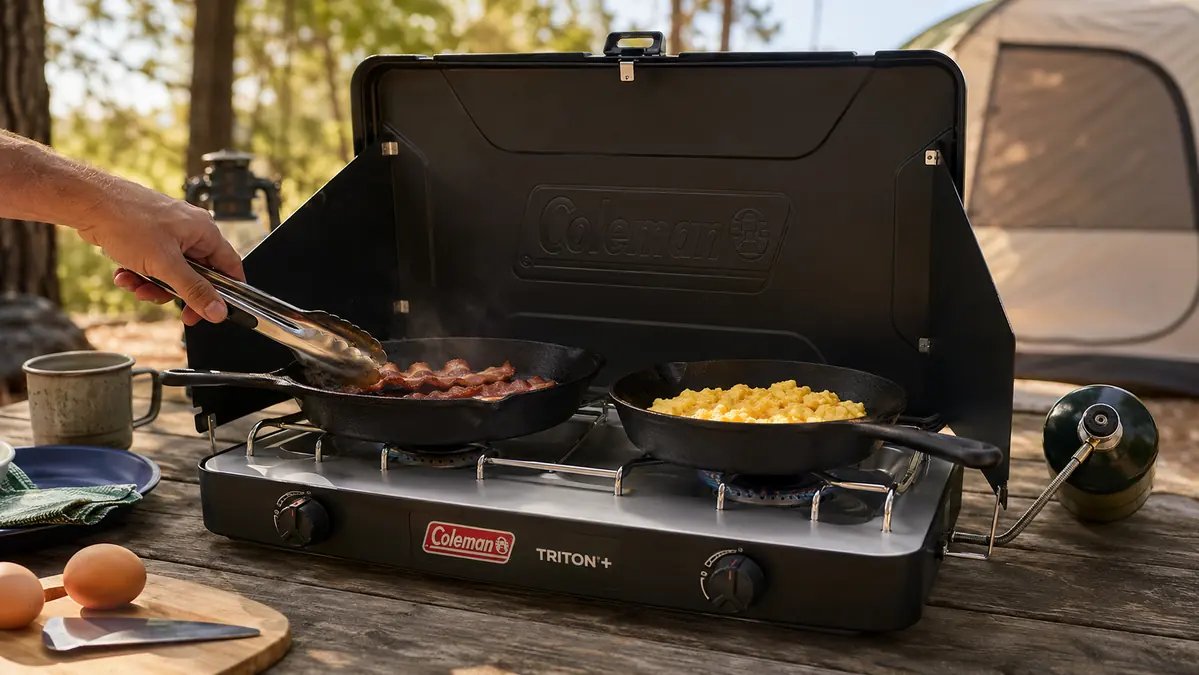
This is where the Coleman Triton+ actually earns its keep over the single-burner stove we used to run. I flip the wind guards up on both sides, thread the propane, and press the InstaStart button on each burner, right after the other, so both are lit within about ten seconds of each other instead of me lighting one, cooking on it, then remembering the second one exists. Bacon goes on the left burner first, because that's the side that runs a little hotter at its low setting on our stove, and bacon actually wants that, a firm medium-high heat that renders the fat instead of just sitting there going limp.
I lay the strips in a cold skillet before the burner's even fully hot, which sounds backward but it means the fat starts rendering gradually instead of seizing up and burning on the outside while the middle's still raw. By the time the Triton+'s left burner is up to full heat, the bacon's already moving, and I'm not standing there waiting on a cold pan to catch up to a hot flame.
Step 3: Start the Eggs on the Right Burner While Bacon Renders
The right burner on the Triton+ holds a steadier low simmer than the left, which makes it the better side for eggs, since scrambled eggs cooked too hot turn rubbery fast and there's no un-ruining them once that happens. I pour the pre-whisked eggs into a second pan on the right burner about ninety seconds after the bacon's started, giving myself just enough of a head start that both finish close to together instead of the eggs sitting done and cooling while bacon's still working.
This is the busiest stretch of the whole cook, flipping bacon with one hand and pushing eggs around with the other, and it's exactly the kind of moment that would've been impossible on a single-burner stove without one food going cold while the other finishes. Having both burners running at a heat level suited to what's actually on them, instead of fighting one burner to do two different jobs, is the whole reason this takes twenty minutes instead of forty five.
Once the eggs are close to done, I pull them off a beat early and let residual heat finish them on the plate. Same with bacon, I pull it to the resting plate the moment it's a shade lighter than I actually want, because it keeps cooking in its own heat for another minute or two. Both of those tricks buy me the couple of minutes I need to get pancakes started without anything overcooking while I'm distracted. It took me a couple of ruined batches of eggs to trust pulling them early, but once you see how much they keep cooking off the heat, you stop second-guessing it.
Step 4: Pancakes Go Wherever a Burner Opens Up First
Whichever burner clears first, bacon's usually done before eggs in my experience, gets a quick wipe with a paper towel and takes the pancake pan. The Triton+ doesn't come with a griddle plate, which is one of the few real gaps I'll point out about the stove, so I run a flat nonstick pan across whichever burner opened up, usually the left, where the higher heat actually helps get a good golden color on the outside instead of a pale, slow-cooked pancake.
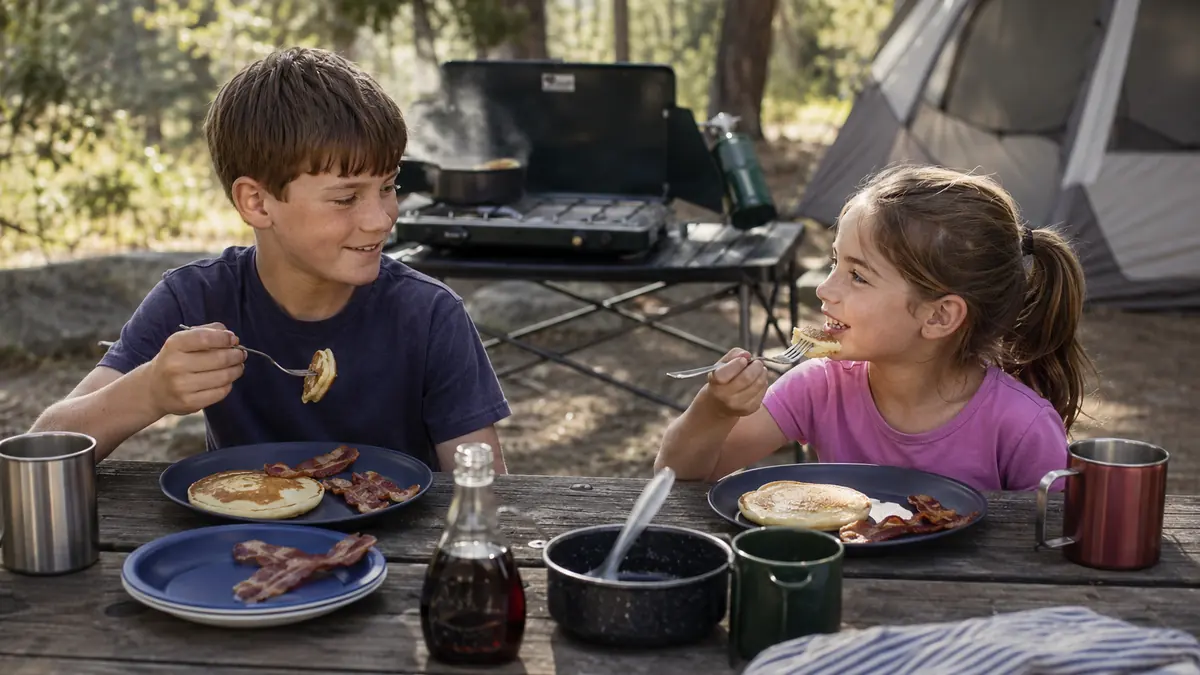
I portion the batter into three pancakes at a time rather than trying to fill the whole pan, since a family of four eating in shifts moves faster than waiting on one giant batch. First three go straight to whoever's hungriest, usually Ivy, while the next three are already going. By the time the last round's flipped, bacon and eggs have both had their rest, and everything lands on the table inside a couple of minutes of each other instead of in three separate waves. On mornings when we're at Osage Hills or Keystone Lake and running a little later than planned, I'll sometimes skip a third pancake round entirely and just cut the first two rounds a little bigger, since a hungry kid doesn't care how many pancakes are on the plate, just that the plate's in front of them.
Step 5: Plate in Waves So Nobody's Food Goes Cold
I don't try to plate all four servings identically at once. I plate the first two, usually the kids, the second bacon and eggs are ready and the first pancakes are off the pan, and let Dana and I finish assembling ours while Nolan and Ivy are already eating. It sounds like a small thing, but it's the single biggest change in how the mornings feel. Nobody's sitting there watching a plate get built for six minutes while their own food cools next to them.
Syrup, butter, and plates get staged on the table before the first pancake even hits a plate, same staging principle as step one, just applied to serving instead of cooking. The whole run, from lighting the Coleman Triton+ to four plates on the table, lands right around twenty minutes once you've done it a handful of times. The first time you try this sequence, budget closer to thirty, you're still learning which pan goes where and how your particular stove holds heat. By the third or fourth trip it's muscle memory, and you stop thinking about the individual steps and just move through them the way you'd drive a route you've done a hundred times.
What Else Helps
A second small pan, not just the one skillet everyone defaults to, changes everything about running two burners at once, since you're never scraping bacon grease out mid-cook to make room for eggs. Pre-whisking eggs at home and pre-measuring pancake mix into labeled bags is a five-minute job the night before that saves real time at the site, and it means one less thing that can go wrong when you're half-awake and the coffee hasn't kicked in yet. I also keep a dedicated resting plate with paper towels under it just for bacon, so grease doesn't pool onto whatever's plated next to it. None of this is complicated. It's just removing decisions you'd otherwise have to make on the fly with two kids standing there waiting.
Coffee gets handled before the propane's even threaded on, either a percolator started over the campfire coals from the night before if we've kept one going, or a pour-over kettle boiled quick on one burner before I start the actual breakfast sequence. I don't try to run coffee at the same time as bacon and eggs, three things fighting for two burners is how the whole system falls apart, so coffee either happens first or it happens on whichever burner opens up last, right after the pancakes come off.
Cleanup matters too if you're doing this again the next morning. I wipe the Triton+'s grates down with a paper towel while they're still warm, before grease has a chance to set up hard, and let the removable grease tray cool before I dump it rather than trying to scrub it hot. It adds maybe three minutes to breakdown but it means the second morning's cook starts from a clean stove instead of one still coated in yesterday's bacon fat.
Two burners running at the heat each food actually wants, instead of one burner doing two jobs badly, that's the whole trick.
I'll add one honest caveat. None of this works if you're improvising the order for the first time at a campsite with two hungry kids watching. Run this sequence once at home on your regular stove, even just to get the timing between bacon and eggs down, before you try to hit twenty minutes at Turner Falls or Lake Tenkiller with an audience. The Coleman Triton+ makes the parallel cooking possible because both burners actually hold their assigned heat level reliably, but the sequence itself is on you. Once you've run it a couple of times, it stops being a system you're thinking through and just becomes how breakfast happens.
Twenty minutes, two burners, one calm morning
This whole workflow depends on a stove that lights the first time and actually holds two different heat levels at once. See today's price on the Coleman Triton+ before your next trip.
Amazon Check Today's Price on Amazon →