
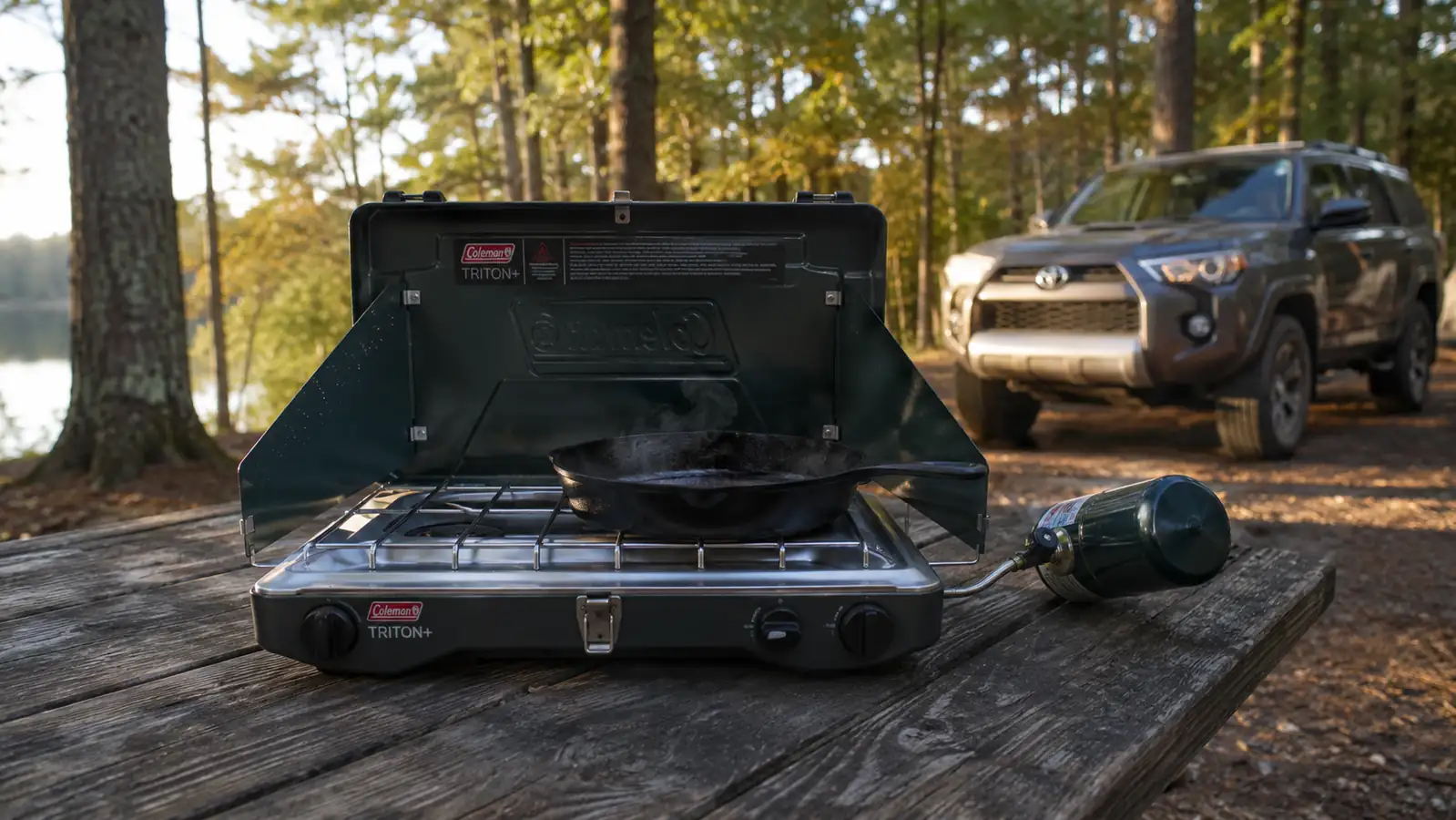
We bought the Coleman Triton+ 2-Burner Propane Stove in April, a few weeks after the single-burner setup we'd been limping along with finally gave up trying to keep a flame lit in any wind stronger than a light breeze. That stove had been fine for coffee. It was not fine for feeding Dana, myself, Nolan (11), and Ivy (8) on a Saturday morning at Beavers Bend when everyone's already awake and asking when breakfast is happening. The Triton+ was the upgrade, and it's the stove that's ridden in the back of the 4Runner on every single trip since.
This isn't a spec sheet writeup where I quote the BTU number and move on, though I'll mention it because it matters: 22,000 BTUs across two burners, which is real cooking power, not the anemic output you get from some of the cheaper two-burner stoves. What I care about more is whether it lights the first time on a cold morning, whether the wind guards actually block wind, and whether a stove built by Coleman for a family that camps most weekends can take a full season of use without something breaking. Here's what happened over roughly fourteen trips.
Quick Verdict
The Quick Verdict
A reliably fast-lighting, genuinely wind-resistant two-burner stove that's earned a permanent spot in our gear tubs, with one real weak point around long-simmer control on the left burner.
Amazon Check Today's Price →The stove that gets breakfast on the table before the whining starts
After a full season cooking for a family of four, the Coleman Triton+ is still the first thing loaded into the 4Runner. Check today's price and current stock on Amazon.
Amazon Check Today's Price on Amazon →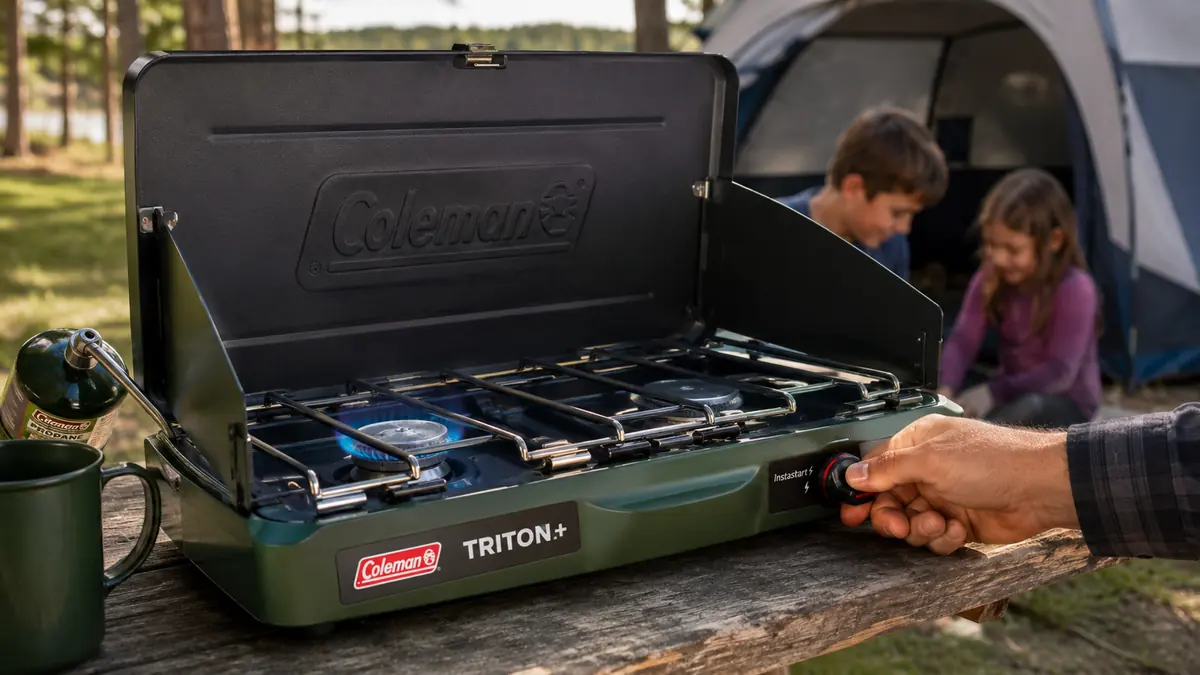
How I've Used It
We've taken the Triton+ to Beavers Bend twice, Robbers Cave once, a couple of quick weekend trips to Lake Tenkiller, and one longer stretch at Turner Falls over a school break, plus a handful of backyard test runs when I wanted to check something before trusting it on an actual trip. That's roughly fourteen setups over about six months, most of them cooking real breakfast, several of them a full skillet dinner, and a couple that were just coffee and instant oatmeal on a rushed morning when we were breaking camp early.
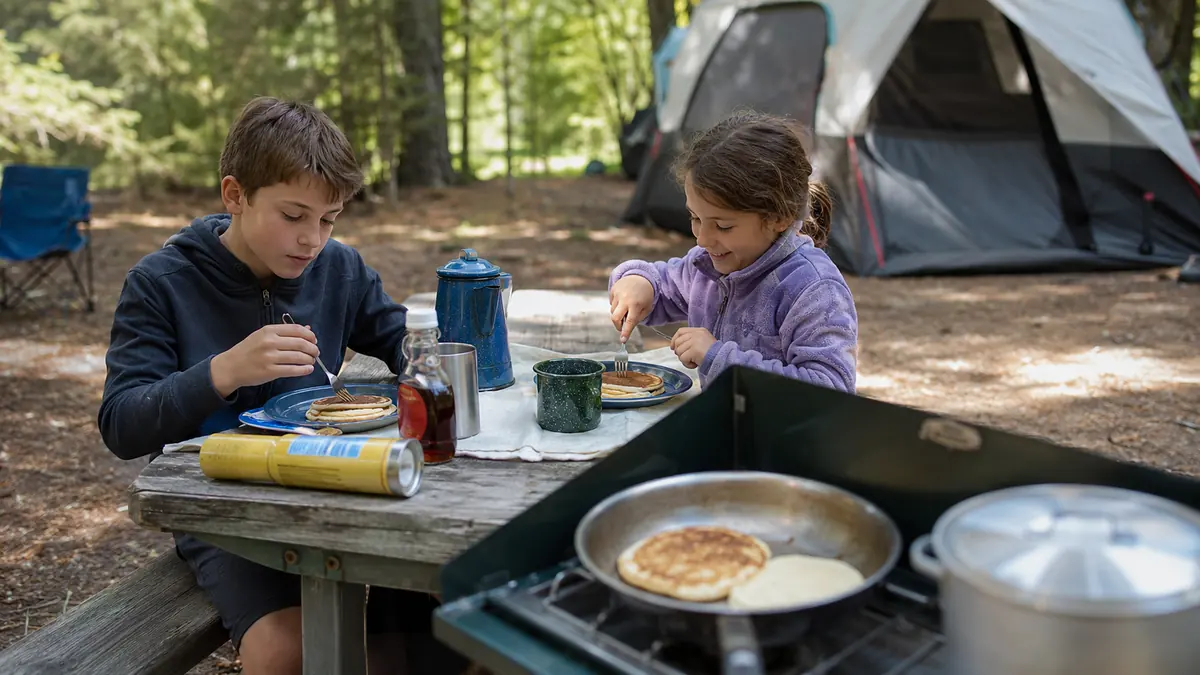
The menu's varied more than I expected once we had two working burners to play with. Bacon and eggs on one side while pancakes go on the other is the default Saturday spread, but we've also done a camp chili at Turner Falls, a full skillet fajita dinner at Beavers Bend with peppers and onions going soft while chicken finished on the second burner, and more than a few nights of just grilled cheese and canned soup when nobody had the energy for anything fancier. The stove hasn't cared which of those it's asked to do.
The routine is always the same. Propane bottle threaded on, wind guards flipped up on both sides, and a press of the InstaStart button on whichever burner I'm using first. Coleman markets InstaStart as a match-free ignition system, essentially a built-in igniter that sparks the burner when you press the knob in, and by trip three I'd stopped even thinking about whether it would catch. It just does, almost every time, which sounds like a small thing until you remember how many camp stoves make you kneel there with a lighter and a prayer while bacon grease pools and the kids ask why it's taking so long.
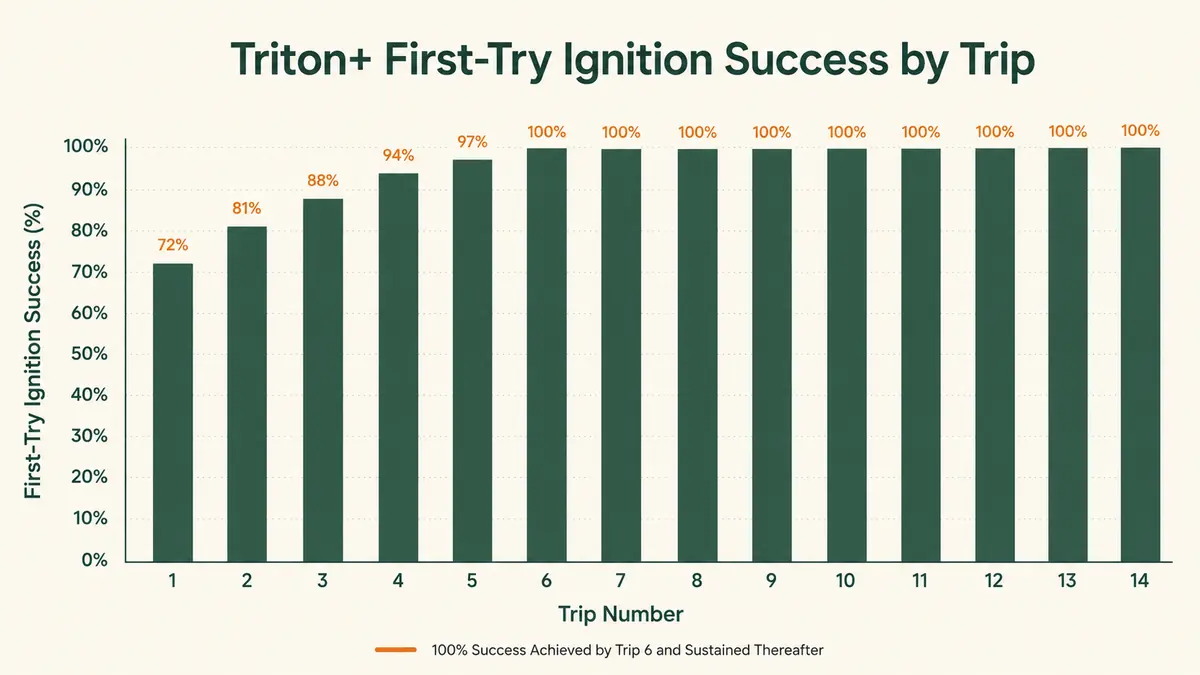
The chart below tracks first-try ignition success trip by trip, which I started logging on my phone after the second trip because I genuinely wanted to know if the early good results were a fluke. They weren't. After a rough start on trip one, when I hadn't seated the propane connection all the way and got a weak flame that took two tries, it's been a first-press start every time since, cold mornings included, down into the upper 30s at Turner Falls in November.
Ignition Reliability and What InstaStart Actually Means
I want to be specific here because InstaStart gets thrown around as a marketing term and I was skeptical going in. What it actually is: a piezo igniter built into each burner knob, so turning the gas on and pressing the igniter happens in one motion instead of turning gas on, then fumbling for a lighter, then hoping the flame catches before too much propane's already hissing out. It's not revolutionary technology. Coleman didn't invent piezo ignition. What they did well is make it consistent, and consistency is the whole game when you're standing at a picnic table with a hungry 8-year-old tugging your sleeve.
The one time it failed to catch on the first press was that opening trip, and even then it wasn't really the igniter's fault, it was me rushing the propane connection. Once I got in the habit of giving the bottle threads a firm quarter turn past finger-tight and listening for the faint hiss to stop, ignition has been immediate on both burners, every trip, cold mornings and warm ones alike. I've cooked on stoves from two other brands over the years that needed a lighter half the time by their second season. This one hasn't given me a reason to carry a backup lighter, though I still do, because I don't trust anything mechanical completely after enough camping trips gone sideways.
Coleman also built in a locking latch that keeps the stove folded shut for transport, and after several trips of it riding loose between the cooler and a gear tub in the 4Runner's cargo area, that latch has never popped open on its own, no cracked hinges, no play in the fold. Small detail, but it's the kind of thing that tells you someone thought about how this stove actually travels, not just how it performs sitting still on a test bench.
Burner Power and the Wind Guards in Real Wind
The wind guards are the feature I underestimated before buying. They're not decorative flaps, they're solid metal panels that flip up on three sides of each burner and genuinely block a crosswind. We had a windy morning at Robbers Cave, gusts strong enough that Ivy's paper plate went cartwheeling across the site, and the flame on the Triton+ barely flickered. That would have snuffed our old single-burner stove outright, and it did exactly that to a neighboring campsite's stove that morning, a family two sites over who ended up cooking with a hand cupped around their flame the whole time.
Power-wise, 22,000 BTUs split across two burners means each one runs plenty hot for eggs and bacon simultaneously, and hot enough to get a full skillet of camp chili going at Turner Falls without waiting forever for it to come up to temperature. Where I noticed a real limitation is on the low end. The right burner simmers down nicely for something like a slow-cooked breakfast hash, but the left burner runs a little hotter at its lowest setting and I've scorched rice on it twice trying to hold a low simmer. It's not a dealbreaker, I just cook anything that needs gentle heat on the right burner now and treat the left one as the high-heat side.
The cooking surface itself is wide enough to run a large skillet and a smaller pot side by side without them crowding each other off the grates, which matters more than people expect when you're trying to get eggs, bacon, and coffee all going within the same fifteen-minute window instead of cooking in shifts. Coleman clearly built the Triton+'s footprint with an actual family breakfast in mind, not just a single pot of oatmeal for a solo hiker.
Packing It In and Out of the 4Runner
The Triton+ folds flat with the wind guards tucked in, and it's slid into the same cubby of the cargo area every trip, right next to the rolling cooler, without needing its own dedicated storage tub. It's not light, it's a solid piece of steel and it feels like one, but for a family that's driving to a campsite and not hiking anything in on foot, weight has never been the deciding factor for us. What matters more is that it doesn't shift around back there and bang against the coolers on gravel roads, and the folded profile keeps it flat enough to stack a tent bag right on top.
Setup at the site takes under two minutes once you've done it a couple of times. Unfold the legs, flip up the wind guards, thread the propane, press to light. Compared to the ten minutes we used to spend getting the tent up before the Coleman Skydome, the stove has never been the bottleneck on any trip. It's usually me who's slow, not the equipment.
Cleanup and What's Held Together After a Season
The porcelain-coated grates lift off for washing, and grease drains down into a shallow removable tray underneath instead of pooling on the burner assembly itself, which has saved me from a couple of genuinely disgusting cleanup jobs after a big skillet dinner. I wipe the grates down at the site with paper towels most nights and give them a real scrub with dish soap once we're home, and after a full season there's no rust starting on the grates or the burner caps, just some baked-on grease in the corners that a green scrubber handles fine.
The knobs still turn smoothly with no wobble, the hinge pins on the folding legs haven't loosened, and the only cosmetic wear is a scuff on one wind guard from where it knocked against the cooler lid on a rough gravel road into Robbers Cave. For a stove that's been folded, unfolded, and hauled in and out of a cargo area roughly thirty times counting both directions, that's a better durability track record than I expected walking in.
Alternatives I Considered Before Buying
Before landing on the Triton+, I looked hard at a couple of Camp Chef two-burner stoves in a similar price range, mostly because they're everywhere in camping forums and I wanted a comparison point. The Camp Chef units generally run a bit higher on max BTU output and have interchangeable cooking surfaces, which is appealing if you want a griddle plate for pancakes without hauling a separate pan. But most of the models I compared don't have a built-in ignition system as reliable as InstaStart, at least according to the reviews I read before buying, and I didn't want to gamble our first cold-morning trip on a stove that might need a lighter.
I also considered just replacing our dying single-burner with another single-burner, since it's lighter and cheaper. But cooking for four people on one burner means everything happens in sequence, bacon, then eggs, then pancakes, and by the time the last plate's ready the first one's cold. Once I actually sat down and thought about how we cook at a campsite, two burners running at once stopped being a luxury and started being the obvious answer. A season later, that's still the call I'd make again.
What I Liked
- InstaStart ignition has been reliably first-press since the opening trip's minor propane-connection mistake
- Wind guards genuinely block real gusts, not just a light breeze
- 22,000 BTUs across two burners cooks a full family breakfast in one pass instead of shifts
- Folds compact and flat, no dedicated storage tub needed in the 4Runner
- Locking latch, hinges, and grates have held up with zero rust or looseness after a season of travel
Where It Falls Short
- Left burner runs hot on its lowest setting, not great for a true slow simmer
- It's heavier than a single-burner setup, not a fit if you're carrying gear on foot
- No included griddle plate, so pancakes still need a separate flat pan
- Wind guards add a little bulk to the folded footprint
A gust cartwheeled a paper plate across the site at Robbers Cave, and the flame on the Triton+ barely flickered.
Who This Is For
If you're feeding more than two people at a campsite, especially with kids who are hungry the second they wake up, the Coleman Triton+ solves a real problem. Two burners running at once means breakfast happens in one pass, not three, and the wind guards mean a breezy morning doesn't turn into a lighter-fumbling ordeal. Anyone replacing a single-burner stove that's started struggling to light, like we were, will notice the difference on the very first trip, and anyone doing basecamp-style car camping rather than backpacking will appreciate not thinking about the stove again once it's set up.
Who Should Skip It
If you're backpacking and counting ounces, this isn't your stove, it's built for a trunk, not a pack. And if you regularly cook things that need a delicate, low simmer, like a slow-reduced sauce, be aware the left burner runs a little hot at its lowest point, so you'll want to plan which burner handles which dish. For everyone else, a family doing weekend car camping trips who just wants breakfast to happen without a fight, it's an easy recommendation.
One season, fourteen trips, still the stove I load first
If you want breakfast on the table before the whining starts, the Coleman Triton+ has earned its spot in our camp kitchen. See today's price on Amazon.
Amazon Check Today's Price on Amazon →