
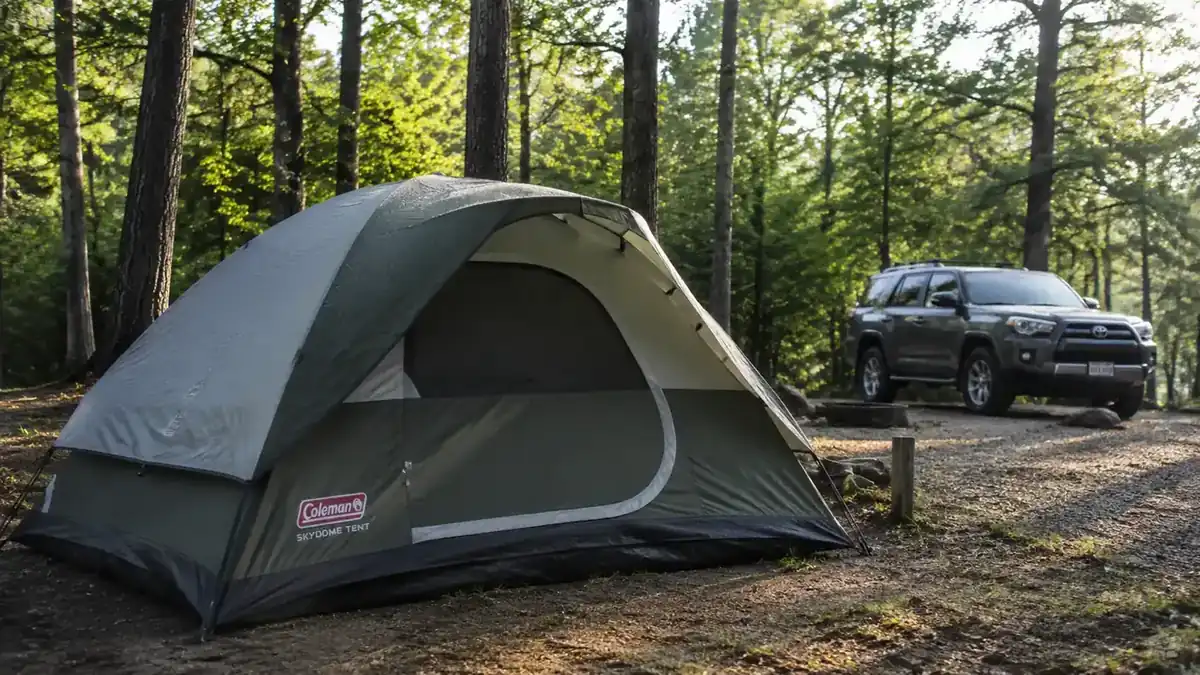
The first time I pitched the Coleman Skydome, it was raining sideways at a campground outside Tahlequah and my son Nolan was standing there with his backpack on, asking how much longer. That's not a great test environment for a tent review, but it turned out to be the most honest one I could've asked for. I've now put this tent through a full camping season, twelve weekend trips, everything from a dry 100-degree August night to that first miserable rainy setup, and I still load it into the back of our 4Runner every time we head out.
This isn't a spec sheet review. I'm not going to tell you the denier count of the fabric because honestly I don't know it off the top of my head and neither do you before you buy a tent. What I can tell you is how the Coleman Skydome behaved with my wife Dana and our two kids, Nolan (11) and Ivy (8), sleeping in it across a season of real Oklahoma weekends within about a four-hour drive of home. We're a car camping family, not backpackers, so everything below is judged by that standard, not against some three-pound ultralight shelter you'd carry ten miles into the backcountry.
Quick Verdict
The Quick Verdict
A genuinely fast, weatherproof family tent that earns its price after a season of real use, with a couple of caveats around ventilation and the rainfly fit in high wind.
Amazon Check Today's Price →Still the tent I grab first before every trip
After a full season of car camping with two kids, the Coleman Skydome is the one that's still in rotation. Check today's price and current stock on Amazon.
Amazon Check Today's Price on Amazon →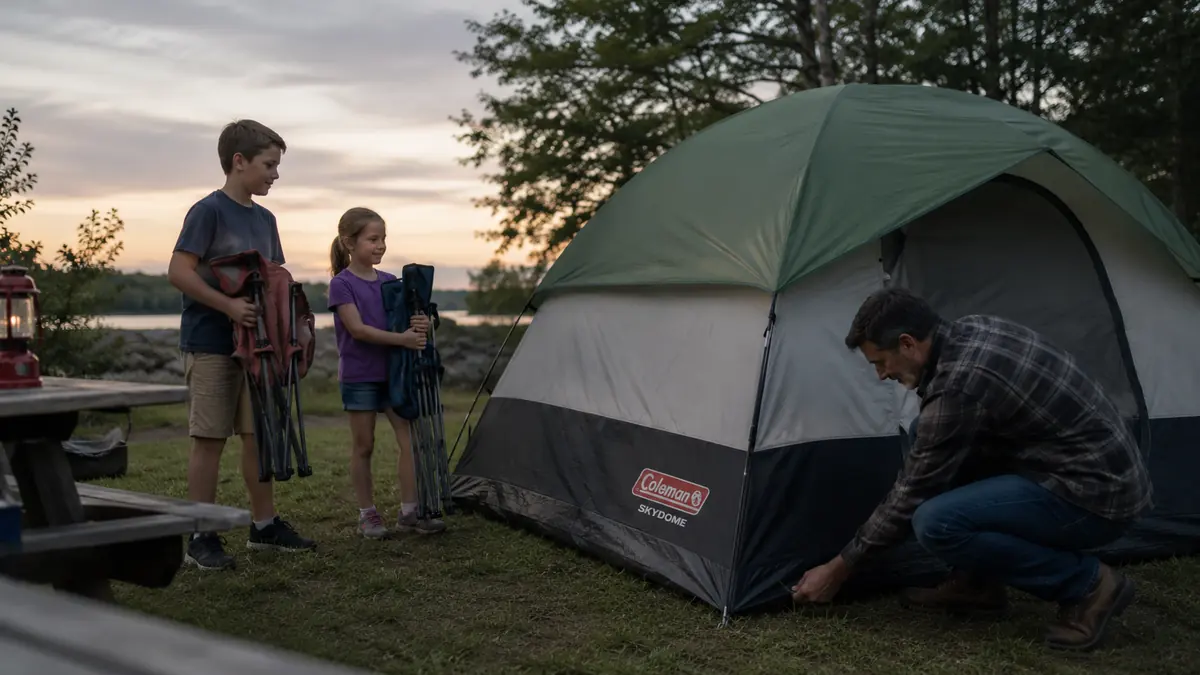
How I've Used It
We bought the 6-person Coleman Skydome in early spring, mostly because our old dome tent had a broken pole segment we never got around to fixing and I wanted something Dana could help pitch without needing me to hold three poles at once. Over the season we took it to Beavers Bend twice, Robbers Cave once, a couple of quick overnighters at Lake Tenkiller, and a handful of backyard shakedown nights when Ivy wanted to 'camp' but nobody wanted to actually drive anywhere.
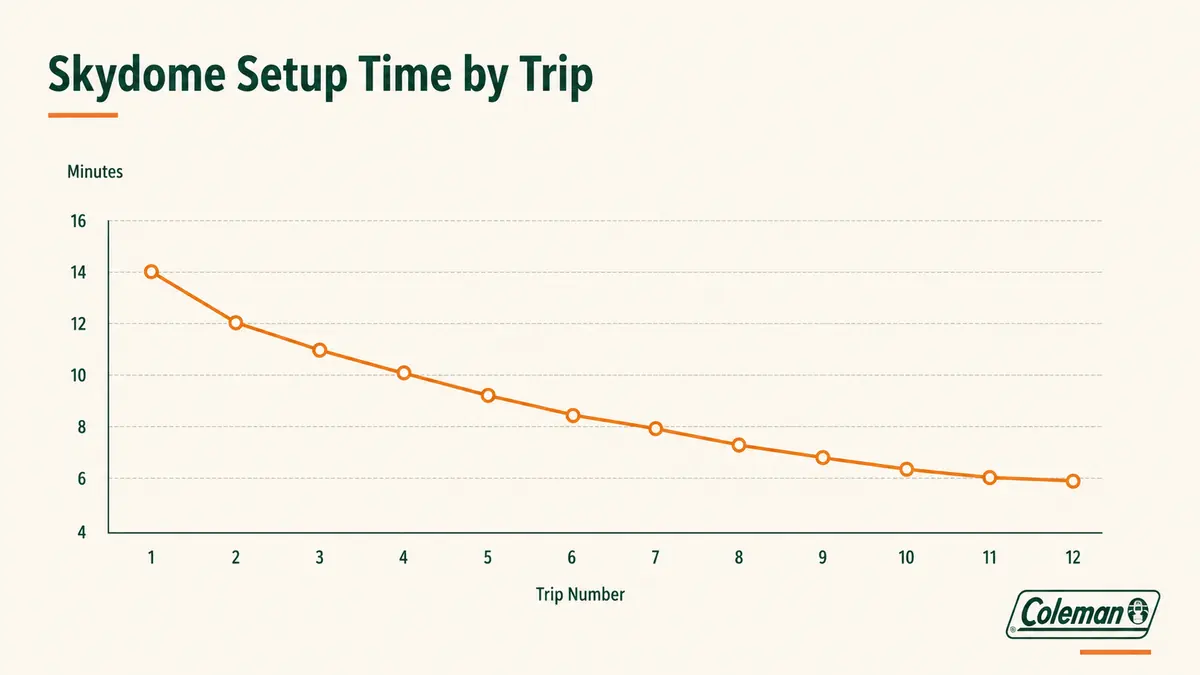
Every trip started the same way. Tent bag out of the 4Runner's cargo area, unrolled on whatever patch of ground looked least lumpy, and the two-pole hub system snapped into place. Coleman built this thing around a claim of five-minute setup, and by trip three, once I'd stopped fumbling with the color-coded clips, I was consistently under eight minutes on my own. With Nolan holding a corner steady, we got it down to six.
The image below tracks setup time trip by trip. It's not a scientific study, just me with a phone timer, but the trend is real. The learning curve on this Coleman tent is short, and once your family has a rhythm for it, the whole pitch-to-camp-chair window shrinks fast. That matters more than people expect when you've got a hungry 8-year-old and forty-five minutes of daylight left.
What's Actually Different From Our Old Dome Tent
The biggest functional change from the old tent we replaced is the pole architecture. Instead of three separate poles you thread through fabric sleeves one at a time, the Skydome uses two pre-bent poles that snap into a plastic hub at the peak. You're not threading anything blind, you're just walking each pole end to its corner grommet and clipping the fabric to it as you go. That single design choice is most of why setup time dropped from the fifteen-plus minutes our old tent took to something closer to eight.
The rainfly is a full-coverage design rather than the partial cap our old tent had, and that turned out to matter more than I expected. It extends down past the mesh windows on all sides, which is the reason the Tahlequah storm didn't get through the door zippers. The floor is a tub-style construction, meaning the waterproof material wraps up the sides a few inches before meeting the tent body, so water pooling under the tent has to climb over a seam instead of sitting right at floor level.
Coleman also builds in what they call a WeatherTec system, which is really just a combination of inverted seams, welded corners, and that tub floor working together rather than any one dramatic feature. After watching it hold up through real rain and not just a garden hose test, I buy it. It's not flashy, but it's the kind of unglamorous engineering that actually keeps a family dry at 2 AM.
The Rainy Night That Actually Tested It
That first Tahlequah trip is the one that matters most for this review. We arrived with maybe forty minutes of daylight left and a storm cell already visible to the west. I pitched the Skydome faster than I expected under pressure, mostly on adrenaline, and got the rainfly clipped down just as the first drops hit. It rained hard for about three hours that night, the kind of rain that makes you second-guess every seam on a new tent.
The floor stayed dry. The welded corners on the tub-style floor did their job, and the rainfly's coverage extended low enough that water wasn't wicking in at the door zippers, which is where I've had problems with cheaper tents in the past. The one issue was condensation. By morning there was a noticeable amount of moisture on the inside of the rainfly and some on the tent body itself near the foot end, where Ivy's sleeping bag ended up damp along one edge. Not soaked, just clammy. That's a ventilation issue more than a waterproofing failure, and cracking the ground vents the next two rainy nights mostly solved it.
I've since made it a habit to crack both ground vents the second we finish staking, rain or not, and that alone cut the condensation problem down to almost nothing on the remaining trips. It's a small step, easy to forget when you're rushing to beat weather, but it's the difference between a slightly damp morning and a genuinely uncomfortable one.
Room for Four, Realistically Two Adults and Two Kids Plus Gear
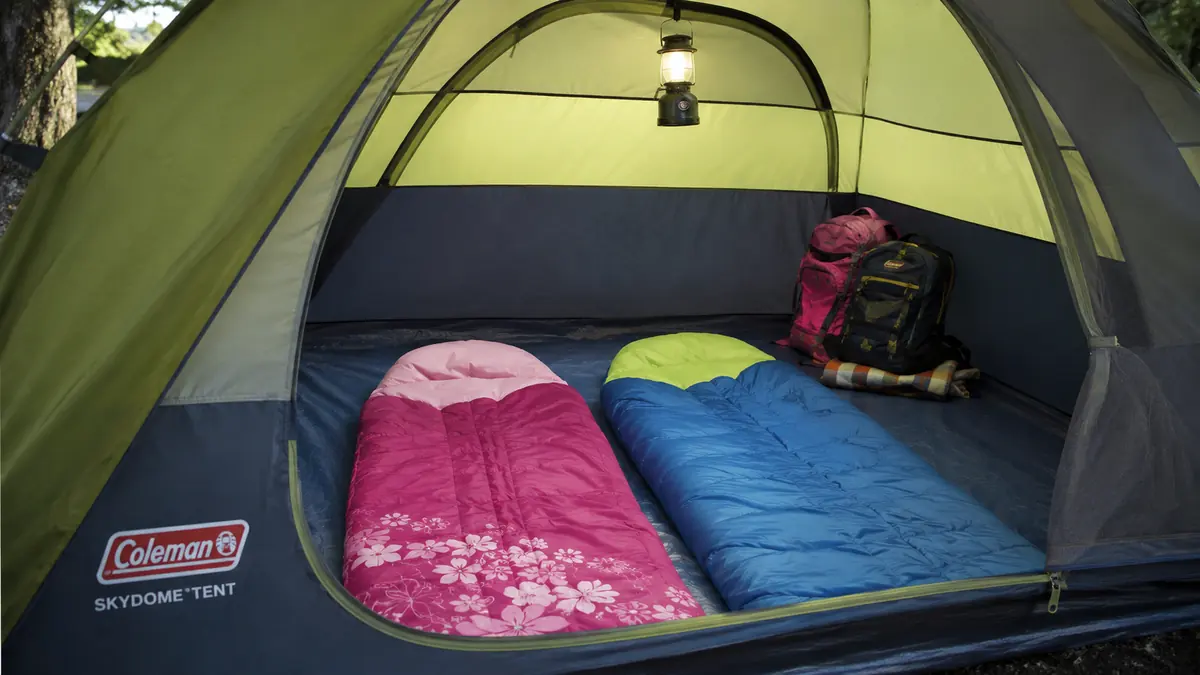
Coleman rates this as a 6-person tent, and I'd push back on that a little. With Dana, myself, Nolan, and Ivy, plus our sleeping bags, two duffels, and Ivy's stuffed animal collection that somehow grows every trip, the floor space felt appropriately full, not cramped, but not spacious either. I wouldn't want to add a fifth sleeper. For our family of four, though, it's been exactly the right size, and the 20% headroom bump Coleman advertises over older dome designs is noticeable. I'm 5'11 and I can stand mostly upright near the center, which matters a lot when you're getting a squirming 8-year-old into pajamas at 9 PM.
That headroom also makes the tent feel bigger during the day, when we're waiting out an afternoon shower and everyone's sitting inside on sleeping pads playing cards instead of standing bent over near the walls the way we had to in our old tent. It's a small thing on paper but it changes how much time you're willing to spend inside the tent instead of hunched in the 4Runner.
Setup Time Over a Season, and Where It Held Up
By the fifth or sixth trip, setup had become routine enough that Dana could get the poles hubbed while I staked the corners, and we'd have it fully up, rainfly included, in under ten minutes as a team. That consistency is the biggest thing this Coleman tent has going for it. When you're car camping with kids who are hungry and tired from the drive, a tent that doesn't turn into a 30-minute argument with fiberglass poles is worth a lot.
The zippers are still smooth after a season, no snagging on the door flaps, which is where a lot of budget tents start to fail first. The pole hub, the plastic piece where all four poles meet, showed no cracking despite one trip where a gust at Robbers Cave folded the whole tent sideways before I got the guy lines out. I was sure I'd broken something. I hadn't.
I also checked the stake loops and floor seams closely at the end of the season, since that's usually where a budget-adjacent tent starts to show wear first. No fraying on the loops, no separation at the seams, and the mesh panels haven't torn despite Nolan crawling in and out of the tent more times than I could count. For a tent in this price range, that's a better durability track record than I expected going in.
Where It Struggled
Wind is the honest weak point. The Skydome's dome shape sheds rain well, but it catches wind like a sail if you don't stake it down properly and use the guy lines Coleman includes, which I skipped the first two trips because I was lazy. Once I started staking every loop and running the guy lines on windy sites, it settled down. But if you're the type to half-pitch a tent and hope for the best, this one will punish you for it on an open, exposed site.
The other soft spot is ventilation in humid weather, which I mentioned above. Oklahoma summer nights get sticky, and with the rainfly fully on, airflow through the mesh panels isn't quite enough on a still, muggy night. We've taken to leaving the rainfly partially off on clear nights and only fully sealing it when rain's actually forecast.
Alternatives I Considered Before Buying
Before landing on the Skydome, I looked hard at an instant cabin-style tent from the same Coleman lineup, the kind with pre-attached poles that pop the whole structure up almost like an umbrella. It's genuinely faster to pitch, but it's bulkier in the bag and I wasn't convinced it would fit as cleanly next to our cooler and gear tubs in the back of the 4Runner. I also looked at a couple of off-brand dome tents at a similar price, but the reviews on rainfly coverage were inconsistent enough that I didn't want to gamble on our first real test being a storm, which is exactly what happened anyway.
In the end the Skydome won out because it split the difference well. Faster than our old traditional dome tent, more packable than the instant cabin version, and backed by enough Coleman reviews specific to rain performance that I felt reasonably confident going in. A season later, I still think that was the right call for how our family actually camps.
What I Liked
- Genuinely fast setup once you've done it two or three times
- Floor and rainfly kept us dry through a real thunderstorm
- Good headroom for a family tent in this price range
- Zippers, pole hub, and seams held up with zero failures over a season
- Packs down small enough to still fit around our cooler in the 4Runner
Where It Falls Short
- Condensation builds up on humid nights with the rainfly fully closed
- Wind performance depends heavily on staking and guy lines being used properly
- 6-person rating is optimistic for four people plus gear
- Ground vents are easy to forget and make a real difference when open
The floor stayed dry through three hours of hard rain outside Tahlequah, and that's the test that actually mattered to me.
Who This Is For
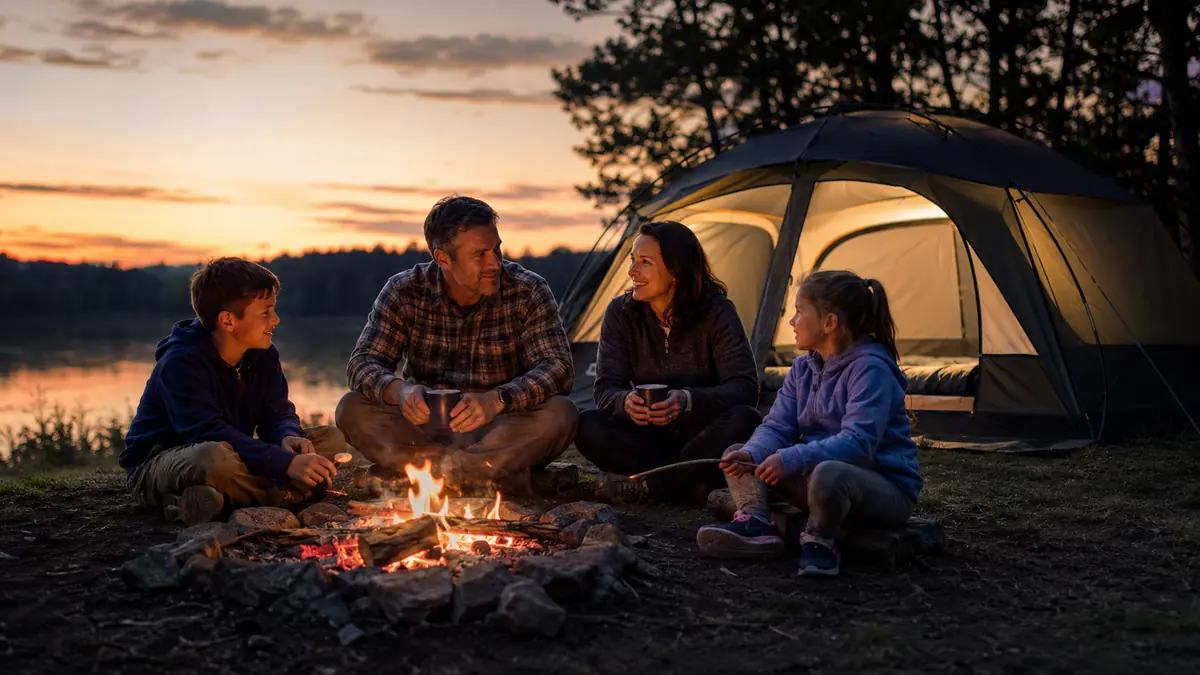
If you're a family doing weekend car camping trips within a few hours of home, the kind where you're pulling up to a campsite in a loaded SUV and not hiking anywhere with the tent on your back, the Coleman Skydome is a smart pick. It rewards a little bit of setup discipline, staking corners and using the guy lines, with genuinely reliable weather protection. For anyone replacing an aging dome tent with broken poles or worn-out zippers, like we were, it's an easy upgrade at this price point.
Who Should Skip It
If you camp in consistently humid, still conditions and hate dealing with condensation, or if you need something ultralight for backpacking, this isn't your tent. It's built for trucks and SUVs, not backs. And if you're regularly camping on exposed, windy ridgelines rather than tree-sheltered campgrounds, budget extra time to stake it properly every single time, because this tent does not forgive a lazy pitch.
One season, twelve trips, still our go-to family tent
If you want a tent that sets up fast and actually keeps a family of four dry, the Coleman Skydome has earned its spot in our gear closet. See today's price on Amazon.
Amazon Check Today's Price on Amazon →