
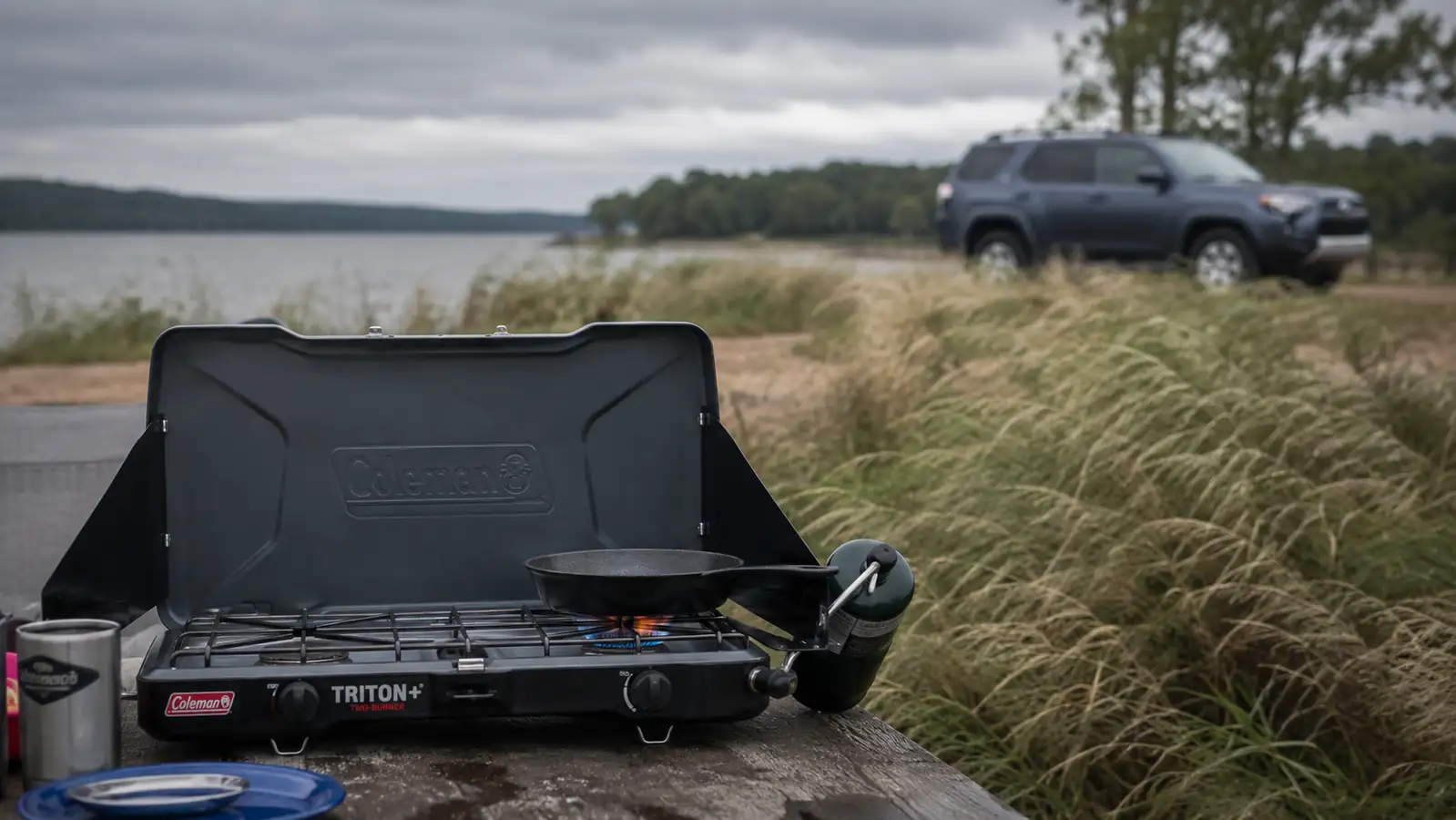
I read enough five star Amazon reviews for the Coleman Triton+ 2-Burner Propane Stove before buying one that I started wondering if half of them were describing a different stove. Every review said the same three things: instant ignition, blocks any wind, never fails. After eight months of hauling ours out of the back of my 2016 4Runner for trips around northeast Oklahoma, most of that holds up. Not all of it. This is the review I wish someone had written before I bought mine, the one that tells you where the Triton+ genuinely earns the compliments and where it's just okay.
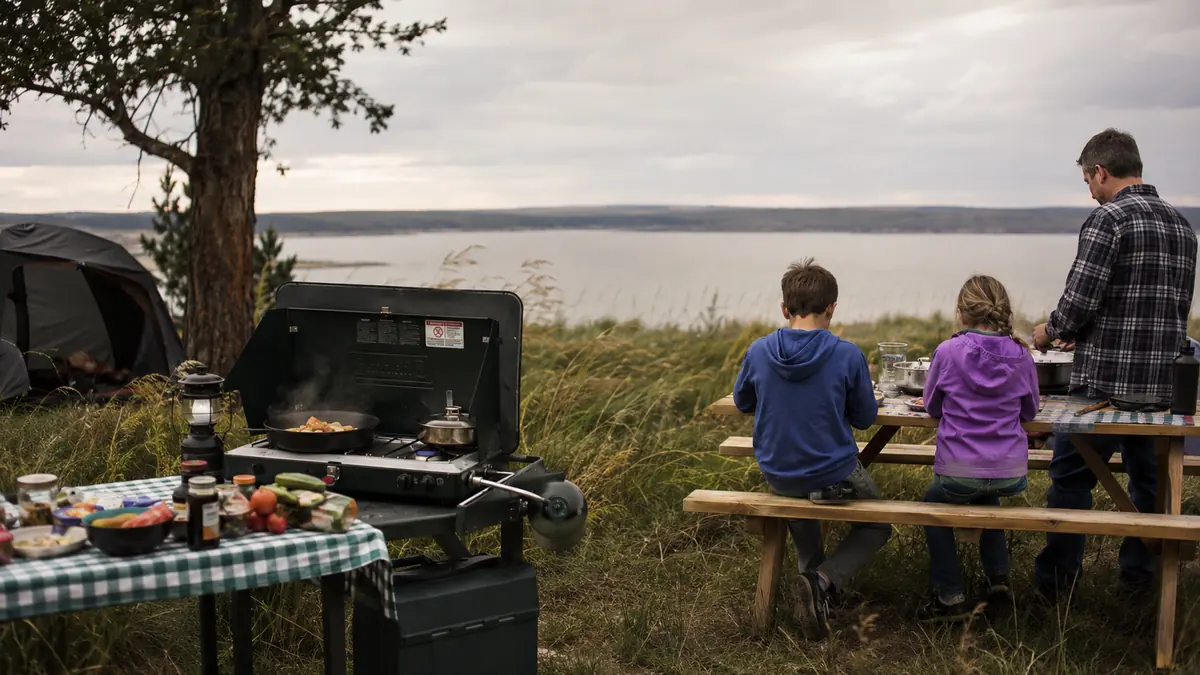
My wife Dana and I camp with our two kids, Nolan who's 11 and Ivy who's 8, on trips that rarely go further than four hours from home. Robbers Cave, Osage Hills, Keystone Lake, wherever we can get a decent site for a weekend. Cooking for four people at a picnic table is the actual test this stove has to pass, not a marketing photo of a solo hiker boiling water for one. So here's the unfiltered version, quirks included.
The Quick Verdict
A stove that lights fast and blocks real wind about as well as the reviews promise, but a real gap between the two burners at low settings and a couple of small annoyances keep it from being flawless.
Amazon Check Today's Price →Before you take the five-star reviews at face value
I put the Coleman Triton+ through eight months of real family cooking to see which claims hold up. See today's price and current availability on Amazon.
Amazon Check Today's Price on Amazon →How We Tested It
This isn't a stove I set up once in the backyard and called it a review. We've taken the Triton+ on eleven trips since last December, split between Osage Hills in the cold months, two trips out to Keystone Lake in the spring, a return to Robbers Cave in early summer, and a handful of quick overnight runs to Turner Falls when we just wanted to get out of the house for a night. Every one of those trips, the stove cooked at least one real meal, not just a pot of coffee.
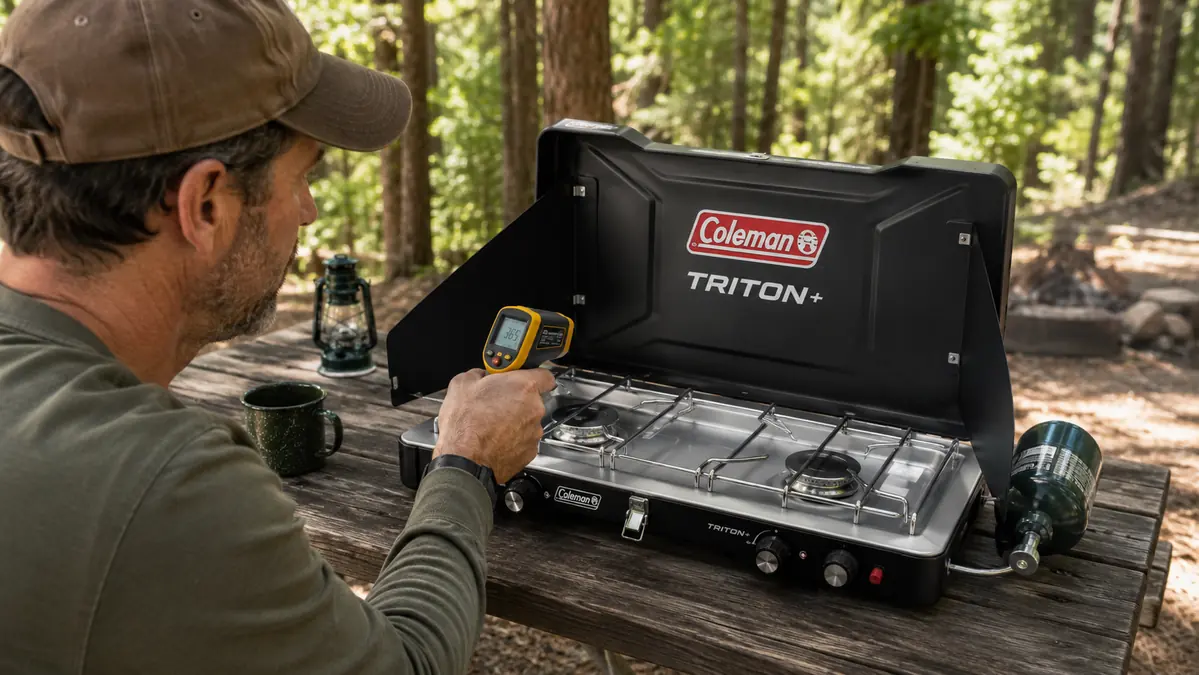
I also did something I hadn't bothered doing with any stove before this one. I bought a cheap infrared thermometer gun and started pointing it at the grates on both burners at different knob settings, mostly because I got tired of guessing why one side of my skillet always cooked faster than the other. Some of what follows comes straight from that, actual numbers, not just a gut feeling about which burner runs hotter.
None of this is lab testing. It's a dad with a twenty dollar thermometer gun and eleven weekends worth of curiosity. But it's more than most reviews bother with, and it's enough to tell you where Coleman's marketing lines up with reality and where it doesn't quite.
The InstaStart Claim, Tested in the Cold
Coleman's InstaStart pitch is that you press a button and the burner lights, no matches, no lighter, no fumbling around. Across eleven trips, it caught on the first press roughly nine times out of ten, which is genuinely good. But it wasn't perfect, and I think reviews that call it flawless are grading on a curve. At Osage Hills in January, with the temperature sitting in the low 30s before sunrise, the right burner took three presses to catch. The igniter clicked, sparked, and just didn't find enough gas flow in that cold to light on the first two tries.
That's not a dealbreaker. Piezo igniters in general struggle a little more in real cold, it's not unique to Coleman. And once it caught, it stayed lit fine the rest of the trip. But if you're the kind of camper who reads InstaStart and pictures a lighter you never have to think about, know that a genuinely cold morning is where it's most likely to make you press the button twice. I keep a small butane lighter in the stove's carry bag now, not because I need it often, but because that one slow morning at Osage Hills taught me not to assume.
The left burner, for whatever reason, has been more consistent than the right one on cold starts, catching first press even when the right one needed a second try. I don't have a good explanation beyond normal manufacturing variance, but it's the kind of detail you only notice after enough trips in genuinely cold weather, which a lot of five-star reviews written after one warm-weather outing simply haven't hit yet.
Wind Guards: Good, Not a Force Field
The wind guards work. I want to say that clearly, because I was skeptical when Coleman advertised them as a headline feature rather than just a spec on a list. At Keystone Lake, where the wind coming off the water is basically constant and usually gusting harder than anywhere else we camp, the flame held steady enough to finish a full breakfast without me hovering over it with a cupped hand the whole time. That part of the reputation is earned.
What the marketing photos don't show is what happens when the wind comes from an angle the guards weren't built for. The panels flip up on three sides, front and both ends, but the back of the burner assembly, where the propane hose connects, is more exposed. On a gusty afternoon at Keystone Lake making a late lunch, wind coming almost straight off the water caught the flame from behind the guard and knocked it down to barely a flicker for a few seconds before it recovered on its own. It didn't go out, but it wasn't the total wind immunity some reviews seem to imply.
So my honest take: the wind guards handle the wind you'd expect at a normal campsite, coming across the table from the side, extremely well. A stiff, steady gust from directly behind the stove is still going to test it. If you camp somewhere consistently exposed, and Keystone Lake's shoreline sites are about as exposed as it gets around here, it's worth angling the whole stove so the guards actually face the wind instead of assuming it'll handle any direction equally.
The Simmer Problem, With Actual Numbers
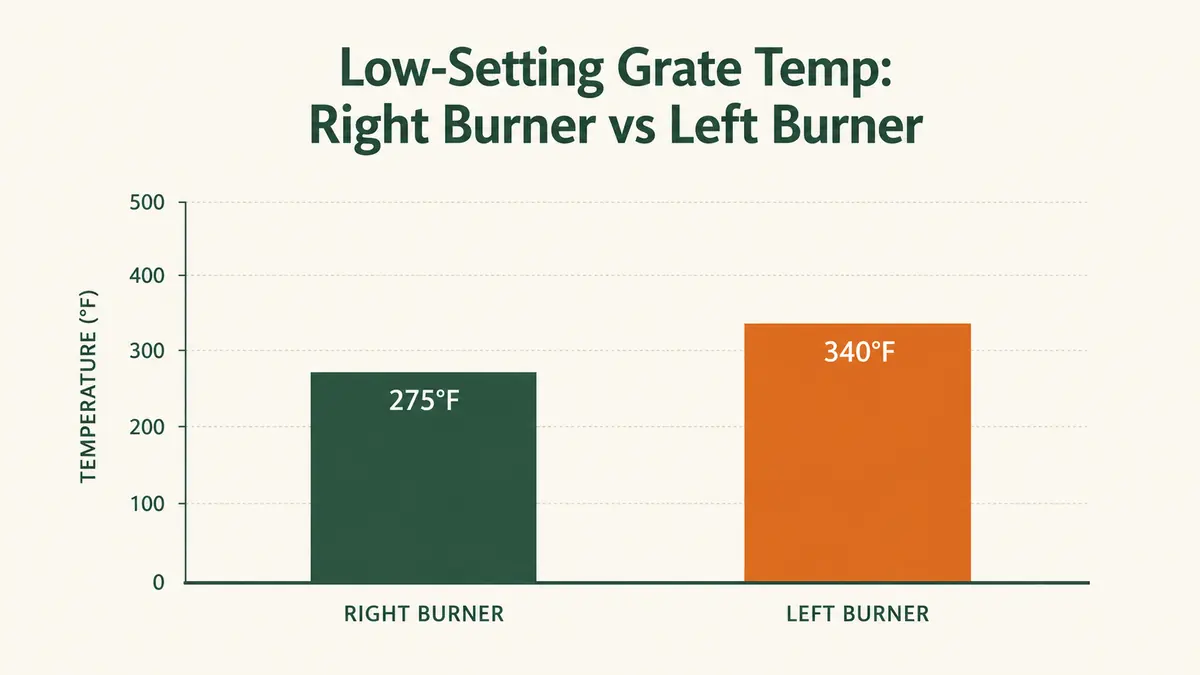
Anybody who's used this stove for more than a few trips eventually notices the burners don't run identically at low settings, and I wanted to know by how much instead of just guessing. At the lowest visible flame setting, my infrared thermometer read the right burner's grate holding around 275 degrees, which is a workable low simmer. The left burner at the exact same knob position read closer to 340 degrees, hot enough that a simmering sauce or a pot of oatmeal will still gently bubble instead of holding still.
I scorched a pot of camp chili at the bottom on the left burner at Turner Falls before I figured this out, thick enough that a chunk of it stuck and burned while the rest was fine. Once I started treating the right burner as the only one I trust for anything that needs to sit at a true low simmer, oatmeal, rice, a slow-reduced sauce, it stopped being a problem. But nobody tells you this going in. The listing photos show two identical-looking burners, and functionally they're not identical at the low end.
This is a small thing in the scope of a stove in this price range that mostly does what it says, but it's exactly the kind of detail that gets left out of reviews written after two or three trips. You need to actually try holding a low simmer, more than once, on both burners, before you notice the gap.
Small Annoyances Nobody Mentions
None of these are big enough to earn their own paragraph in most reviews, but eight months in, they add up to the difference between a stove I like and a stove I'd call perfect. The propane hose connector has a knurled ring that's slightly harder to read in low light than it should be, so the first couple of trips I found myself checking it with a headlamp to make sure it was actually threaded on straight before lighting up, since a crooked connection wastes gas and never seals fully.
The right wind guard hinge has picked up a faint squeak that wasn't there when it was new, nothing that affects function, just a sound I notice now every time I flip that panel up. And the carry handle, while sturdy, sits close enough to the wind guard that if you grab it wrong while the guards are still folded, you can pinch a knuckle. It's happened to me twice, once badly enough that I dropped a spatula.
None of this changes my overall opinion of the Coleman Triton+. It just means the version of this stove that shows up in a lot of glowing reviews, the one with zero quirks, isn't quite the real one. The real one has small rough edges like any piece of gear that gets used instead of admired on a shelf.
The Griddle Question, Answered
The Triton+ doesn't come with a griddle plate, which shows up as a complaint in almost every review I've read. I finally bought a separate flat-top griddle insert sized for this stove to test whether it was worth the extra purchase, and the honest answer is mixed. It fits fine across both burners and makes pancakes and bacon genuinely easier to manage at once instead of juggling a round skillet on one side and hoping the pancakes don't stack up on each other.
But the griddle covers both burners at once, which means you lose the ability to run two separate pans for two separate dishes, which is exactly the flexibility that made me choose a two-burner stove over a single-burner in the first place. I've settled into using the griddle only on mornings when it's just pancakes and bacon together, and going back to two separate pans anytime we're doing eggs plus something else on the side.
Coleman sells a matching griddle accessory sized for this exact stove, and it's been worth having for us given how often breakfast is pancakes with two kids voting on the menu. But it's a genuine add-on cost on top of the stove itself, not something I'd assume you need before your first trip. Try a few meals with the stock grates first and decide from there once you know how you actually cook at a campsite.
Is It Worth More Than the Cheaper Two-Burners
Every camping forum has a thread arguing whether it's worth spending more than the bargain-bin two-burner stoves that show up in the same search results. I get it, our old single-burner cost a fraction of what the Triton+ runs today, and it worked fine for exactly as long as it needed to before the ignition gave out and Dana got tired of watching me wrestle a lighter over bacon grease on a cold morning. Eight months in, I think the gap in current price actually reflects a real gap in what you're buying, not just a brand name tax.
I borrowed a neighbor's off-brand two-burner at Robbers Cave last summer when our own propane hose needed a spare part mid-trip, just to compare the two side by side over one meal. It lit fine on a calm morning, but the grates were noticeably thinner, flexing slightly under a full skillet, and it had no wind guards at all, just an open flame exposed on every side. That stove would have folded completely under the same gust that barely dimmed the Triton+ at Keystone Lake.
So is it worth paying more than the cheapest option on the page? For a family that cooks a real breakfast most trips and camps in a mix of conditions, yes. If you're occasionally boiling water for instant coffee on a mild weekend, probably not, and a cheaper stove will do that job fine. The Triton+ earns the difference doing the things that only show up after repeated use: staying lit in wind, holding its shape under a heavy skillet, and not needing replacing after one rough season.
What I Liked
- InstaStart catches on the first press about nine times out of ten, cold mornings included
- Wind guards genuinely cut wind coming from the sides, tested at a consistently windy lakeside site
- 22,000 BTUs is plenty of real heat for eggs, bacon, and a skillet dinner cooking at once
- Compact folding profile that's ridden in the same cargo spot for eleven trips without shifting
- Held up with no rust, no loose hinges, and no cracked ignition button after nearly a year
Where It Falls Short
- Cold mornings can mean two or three presses instead of one on the right burner
- Left burner runs noticeably hotter at low settings, about 65 degrees hotter by my thermometer, making it a poor choice for a true simmer
- Wind guards don't fully cover a gust coming from directly behind the stove
- Minor squeak developing in one wind guard hinge after months of folding and unfolding
- No included griddle plate, so pancake-heavy mornings need a separate accessory purchase
My thermometer gun read 275 degrees on the right burner and 340 on the left, at the exact same knob position. Nobody puts that in a five-star review.
Who This Is For
If you want an honest, mostly reliable two-burner stove for feeding a family at a campsite, not a flawless one, the Coleman Triton+ earns its keep. It's for campers who cook real meals rather than boiling one pot of water, who camp in a mix of conditions including the occasional cold morning or windy lakeside site, and who don't mind learning a stove's quirks over a season instead of expecting it to behave identically to the marketing copy from trip one.
Who Should Skip It
If you need a stove that lights on the very first press every single time with no exceptions, especially in cold weather, or if you regularly cook something that needs a delicate, rock-steady simmer on both burners at once, this one will occasionally frustrate you. It's a good stove with a couple of real limitations, not a perfect one, and if perfect is what you're expecting after reading a stack of five-star reviews, it's worth adjusting those expectations before you buy.
The honest version, not the highlight reel
Nine-out-of-ten first-press ignition, wind guards that actually work, and a simmer quirk worth knowing about before you buy. See today's price on Amazon and decide for yourself.
Amazon Check Today's Price on Amazon →